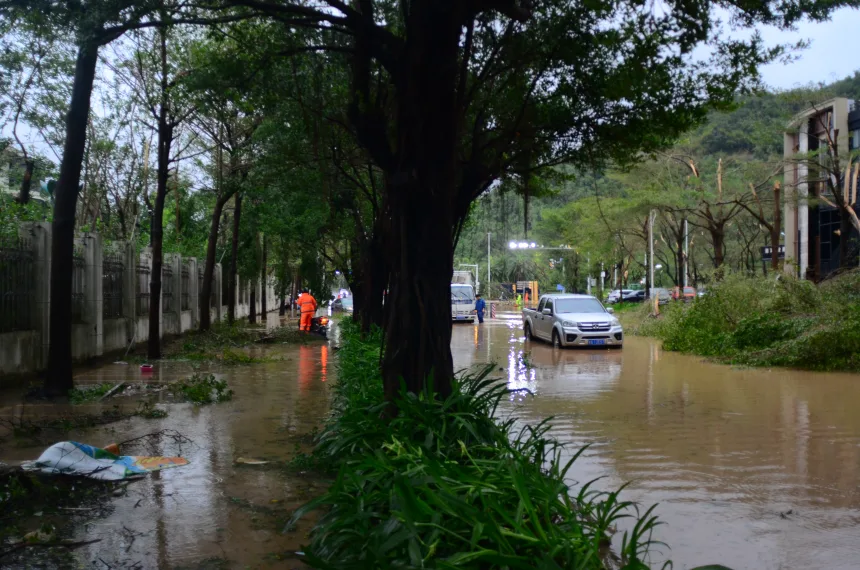
Vietnam has shut down schools, grounded flights, and evacuated tens of thousands of residents as the country braces for Typhoon Kajiki, the most powerful storm to strike its shores this year.
The storm, packing sustained winds of up to 166 km/h (103 mph), swept through China’s southern Hainan Island on Sunday before crossing into the Gulf of Tonkin. Vietnam’s national weather agency has classified it as the equivalent of a Category 2 Atlantic hurricane, warning of destructive winds, storm surges, and torrential rains.
Mass Evacuations and Emergency Measures
As of Monday morning, more than 40,000 people had already been moved from low-lying coastal communities, according to the state-run VN Express. Authorities have ordered residents to remain indoors between 11 a.m. and 6 p.m. local time.
Vietnam’s government has prepared a wider evacuation plan for nearly 600,000 people across Thanh Hoa, Quang Tri, Hue, and Danang provinces. Fishing vessels have been ordered to stay ashore, while emergency crews have begun reinforcing dams and flood barriers.
Over 300,000 military personnel, including naval, coast guard, and air force units, have been mobilized for rescue and relief operations, the Vietnamese News Agency (VNA) confirmed.

Flights and Schools Closed
The Civil Aviation Authority closed two provincial airports in central Vietnam on Monday, forcing airlines to cancel or delay dozens of flights. Schools in Thanh Hoa province were also shut down for at least two days.
Businesses and households across the region rushed to secure properties by boarding windows and stacking sandbags against rising floodwaters.
Dangerous Storm Surges Expected
Authorities have warned of storm surges up to 1.5 meters, with sea levels in some areas expected to rise beyond 3.5 meters. Heavy rainfall of 200–400 millimeters is forecast in several regions, with isolated areas facing more than 600 mm — increasing the risks of flash flooding and deadly landslides.
Kajiki is expected to make landfall Monday evening in Thanh Hoa and Nghe An provinces, around 166 kilometers south of Hanoi, likely as a weakening typhoon or strong tropical storm.
Comparisons to Last Year’s Deadly Storm
Officials have drawn comparisons with Typhoon Yagi, which devastated northern Vietnam in 2024, killing nearly 300 people and destroying vast stretches of farmland and infrastructure. While Kajiki is weaker, its speed and intensity still make it a grave threat.
Impact Beyond Vietnam
China’s southern provinces of Hainan and Guangdong have already been battered, with reports of fallen trees, flooded streets, and damaged vehicles. Authorities in the resort city of Sanya closed tourist attractions, halted public transport, and raised the country’s highest typhoon alert before downgrading it Monday morning.
Meanwhile, meteorologists expect Kajiki’s remnants to bring heavy rains to parts of Laos and Thailand as the storm moves inland and weakens into a tropical depression by Tuesday.
Source – Trendzgh
About The Author